I’ve used a lot of Linux distributions over the years. Fedora was my daily driver for over 2 years, and it served me well. But I always felt like something was missing I wanted more control over my system. I’d heard about Arch for years, but honestly? It seemed intimidating, and I kept putting it off.
 My current desktop environment using Hyprland with my own customized dotfiles.
Then I stumbled upon the “rices” those gorgeous, highly customized Arch setups people share online. I was hooked. I needed to have my own. So I dove into the Arch Wiki, spent way too many hours testing in virtual machines, and finally took the plunge.
What Actually Convinced Me: Tiling Window Managers
Let’s be real Tiling Window Managers (TWMs) were the final push. Seeing those sleek Hyprland setups everywhere made me realize I was missing out. I started with a dual boot setup, keeping Windows around for university stuff and “just in case” compatibility issues.
Spoiler: I quickly grew to hate booting into Windows. After a few months, I nuked it entirely. Why keep something I never used?
It’s been over a year now. I’ve built my own dotfiles and I’m currently running a setup heavily inspired by JaKooLit’s work—with my own personal touches, of course.
Note: My dotfiles are in beta right now, but I plan to share the complete configuration once they’re more stable.
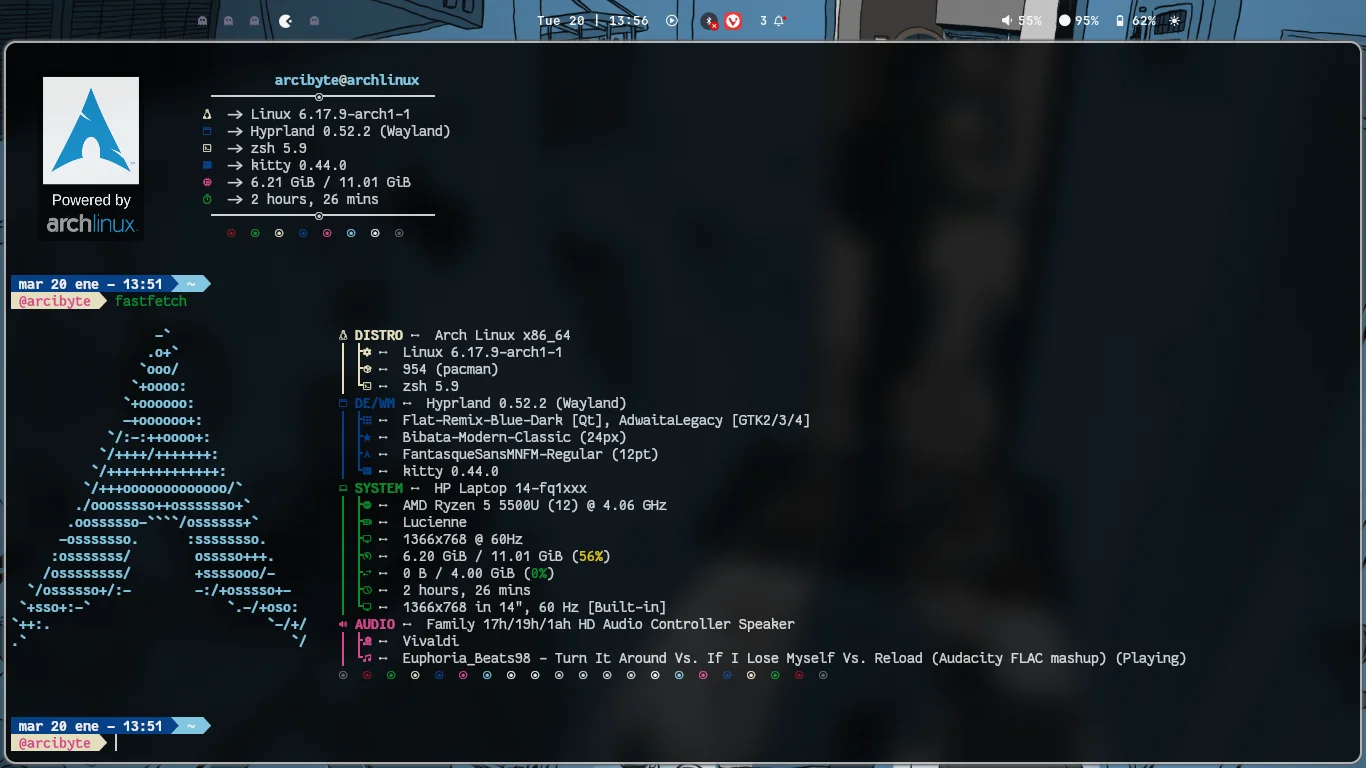 My Arch setup running smoothly—neofetch never gets old.
My Setup: The Pieces That Make It Work
One of the best parts of Arch is choosing every component yourself. Here’s what I’m running:
- Window Manager: Hyprland (Wayland compositor—smooth animations, tiling perfection)
- Terminal: Kitty (GPU accelerated, fast, and looks gorgeous)
- Shell: Zsh with Oh My Zsh (autocompletion and git integration are lifesavers)
- App Launcher: Rofi (quick, customizable, does exactly what I need)
- File Manager: Thunar for GUI, ranger for terminal
- Status Bar: Waybar (shows everything at a glance)
- Notification Daemon: Dunst (clean, minimal notifications)
- Editor: Neovim (because once you learn Vim motions, there’s no going back)
Every single piece is something I chose. That’s the Arch experience.
Why Arch Just Works for Me
1. Complete Control (Zero Bloat)
You install exactly what you need. Nothing more, nothing less. It’s like building your own custom PC versus buying a prebuilt loaded with software you’ll never touch. The system is yours, and it shows.
2. The AUR is a Game Changer
The Arch User Repository (AUR) is genuinely one of the best things about Arch. Need a niche application? It’s probably there. Installation is ridiculously easy with helpers like yay:
# That's it. Seriously.
yay -S visual-studio-code-bin
3. Rolling Releases & Amazing Documentation
No more dreading major version upgrades or reinstalling your OS every couple of years. With Arch’s rolling release model, everything stays current:
yay -SyuAnd when something inevitably breaks (we’ll get to that), the Arch Wiki has your back. It’s hands down the best Linux documentation out there—detailed, updated, and actually helpful.
The Downsides (Because Nothing’s Perfect)
Let’s not sugarcoat it: Arch can break. If you blindly update packages or install things without reading, you will end up with an unbootable system. I’ve had to rescue my install from a USB stick more than once:
mount /dev/nvme0n1p2 /mnt
arch-chroot /mnt
pacman -Syu
The Real Challenges
- Installation: Even with
archinstall, it’s still way more daunting than popping in an Ubuntu USB and clicking “Next” a few times. - Hardware quirks: Proprietary drivers—especially NVIDIA—can be a nightmare to configure properly.
- Time investment: Getting everything just right takes days (sometimes weeks) of tweaking, researching, and troubleshooting.
Should You Use Arch?
If you enjoy tinkering, want to understand how Linux actually works, and don’t mind reading documentation, absolutely give it a shot. It’s rewarding in a way that other distros just aren’t.
For me, Arch became my digital home. I genuinely can’t imagine switching back to something else.
Well… unless it’s NixOS. I’ve been reading about declarative configuration lately, and the idea of a completely reproducible system sounds incredibly tempting. But that’s a whole different rabbit hole for another post.
BTW, I use Arch. 😎